

When I turned 60 and started lifting at the community rec center, my questions were different from the young guys in the mirror. They wanted to know how to get bigger. I wanted to know what would keep me strong, help me recover between workouts, and stop my knees from complaining on the porch stairs. Fish oil came up at my checkup at 62, mostly because I am honest enough to admit I rarely eat fish, and the supplement aisle is wall to wall with bottles that all seem to say the same thing. I wanted a way to sort through them without a degree in nutrition, and I wanted to know what was worth a spot in my morning routine.
So I did what I do with everything now. I asked my doctor whether a fish oil was worth adding. He said it was reasonable, pointed out that I hardly eat fish, and reminded me to take it with food. Then I picked one bottle, the lemon-flavored fish oil from Nordic Naturals, and gave it eight weeks while I kept my normal log in my spiral notebook. This is the checklist I wish I had that day, the one I would hand to any man or woman over 50 who lifts and wonders which bottle to grab. It is not complicated, but nobody laid it out for me in one place, so here it is.
The fish oil I settled on after eight weeks
Two softgels with breakfast, lemon flavor, and no fishy burps when taken with food. Nordic Naturals carries a 4.7-star rating on Amazon with tens of thousands of reviews. Ask your doctor first, then this is a sensible place to start.
Amazon Check Today's Price on Amazon →Step 1: Ask your doctor before you buy anything
This is not the step anyone wants to hear, and it is the one I will not skip. Fish oil can thin the blood a little, so if you are on a blood thinner, this is a conversation to have before you buy a single bottle. Same goes for anyone with a health condition they are not sure about. My doctor knows my history, including the mild knee stiffness from 31 years of walking a mail route, and he gave me the green light with one piece of advice: take it with food.
Bring the label with you, or a photo of it. Doctors see a lot of patients who show up with a jar they already bought and ask if it is okay after the fact. It is easier to walk in and say, "I am thinking about this fish oil, what do you think?" The answer might be that you do not need it at all, which is a perfectly good outcome. The goal is not to buy fish oil. The goal is to make a sensible decision you can live with for the next twenty years.
One more thing while we are here. A fish oil is not a fix for a bad diet or a skipped workout. If you are not eating enough protein, sleeping badly, and missing your lifting days, no softgel in the world will do the heavy lifting for you. The supplement comes after the basics, not instead of them. I say that to every person who asks me what they should be taking.
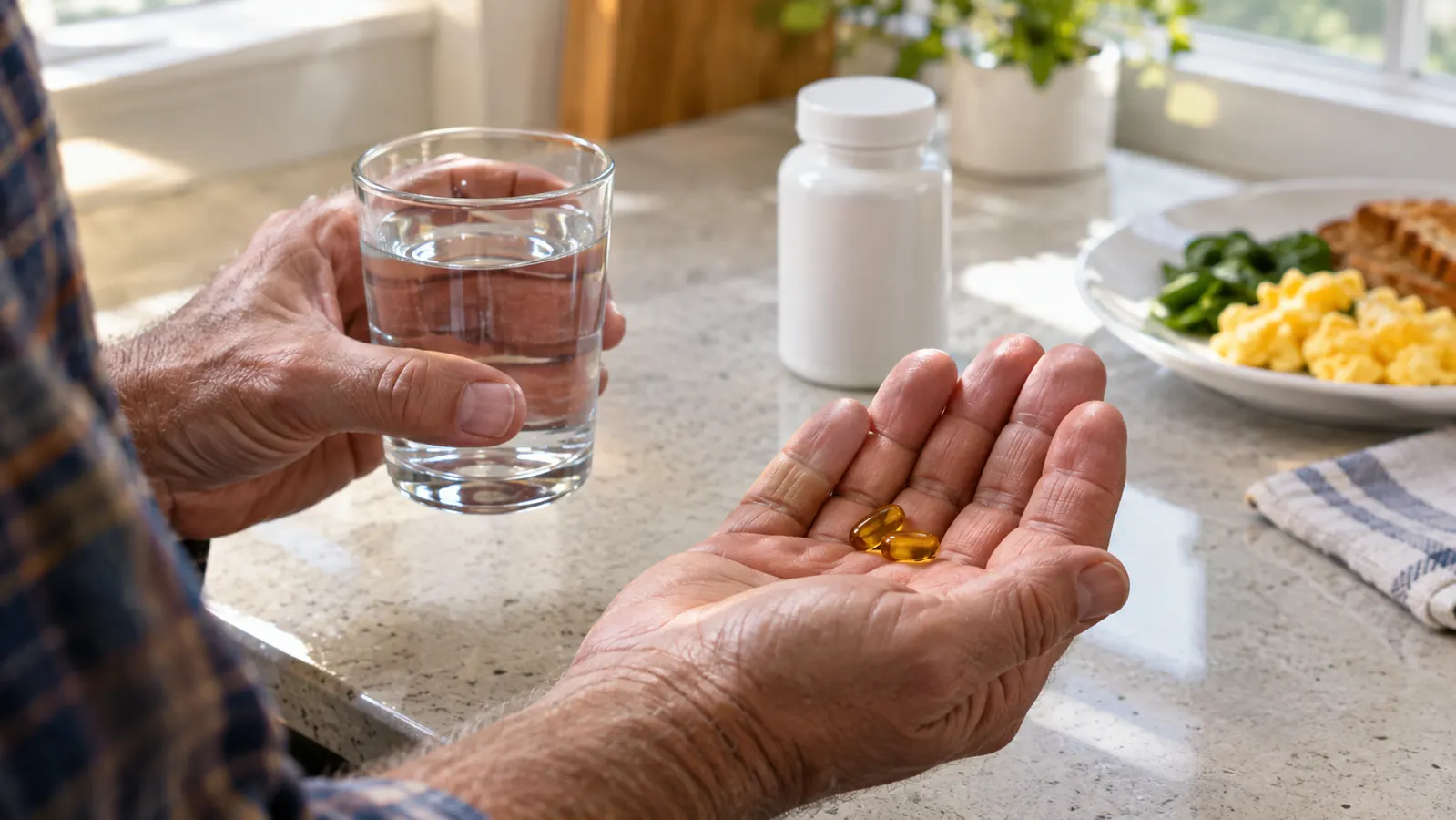
Step 2: Read the label for EPA and DHA, not the front of the bottle
The front of a fish oil bottle tells you the total milligrams, and that number is the marketing number. The number that matters is on the back: how much EPA and DHA is in a serving. Those are the omega-3s your body can actually put to work. Everything else in that total is other fats doing a lot less for you. Once I learned that, I stopped reading the front of bottles entirely. The front can say whatever it wants. The panel is where the truth lives.
When I compared bottles, I read the supplement facts panel the way I read a nutrition label. The Nordic Naturals fish oil I take lists 1,280 milligrams of omega-3s in the two-softgel serving, and the label breaks that down into roughly 650 milligrams of EPA and 450 milligrams of DHA. More EPA than DHA is the kind of ratio a lifter wants to see, because EPA is the one most often linked to joint comfort in the research I have read.
The Nature Made fish oil I tried first did the job, but it gave me more burps. That is not a scientific complaint, it is a practical one. A fish oil you dread taking is a fish oil you will stop taking, and a bottle that sits in the cabinet does nothing for you. When I switched to the lemon-flavored Nordic Naturals, the only fishy burp I got was one morning when I took the softgels on an empty stomach. With food, never.
Step 3: Check how fresh it is and how it was tested
Fish oil goes bad. It oxidizes, and rancid fish oil does not taste like much when it is sealed inside a softgel, but it is not doing you any favors. This is why I am wary of buying a giant value-size jug of something I will not finish before it turns. A smaller bottle that I actually use up is worth more than a big one that sits half-open in the back of the cabinet for months.
Look for a brand that talks openly about third-party testing and freshness. Nordic Naturals has been making omega-3 supplements for decades and answers the testing question on its website, which tells me they expect to be asked. I am not going to pretend I can taste rancidity in a softgel. But a company that is proud of its sourcing and its testing is a company I trust more than one that just puts a bigger number on the front.
The practical test is the burp test, and it is a real one. If a fish oil gives you fishy burps all day, it is either low quality, or you are taking it on an empty stomach. My first week on the Nordic Naturals softgels, I took them with just coffee one morning and learned my lesson. With breakfast, no problem at all. Whatever brand you choose, take it with food and pay attention to how your body responds.

Step 4: Pick a flavor and a routine you will actually keep
Here is the question that matters more than any lab result: will you still be taking this in six months? The best fish oil in the world is worthless if the bottle sits in the cabinet. So I look for three things: a flavor I do not dread, softgels that go down easy, and a routine that is already part of my morning. A bottle I have to remember at noon will get forgotten by Tuesday.
The Nordic Naturals bottle I buy has 90 softgels, and the serving is two a day, so one bottle lasts about six weeks. That is a manageable size. The softgels are on the large side, but they go down fine with water, and the lemon flavor means I do not taste fish. The bottle sits in the kitchen cabinet beside the fridge, right where I pour my coffee, so taking it is part of the same motion as breakfast.
Think about your own routine before you buy. Do you eat breakfast at home? Do you travel? Can you pack a bottle? I keep mine simple: two softgels with breakfast every day, including weekends and trips. If a fish oil needs to be refrigerated or taken three times a day, I know myself well enough to know I will miss doses. Choose the one that fits the life you actually live.
Step 5: Take it with food and give it eight weeks
Here is the honest part, and I think it is the part most reviews skip. I felt nothing dramatic from the fish oil. No energy wave, no sudden improvement in my knees, no extra reps on the leg press. My doctor said that is exactly what to expect. Fish oil is a long-term support thing, not a pre-workout. You are playing the long game with your joints and your heart, not looking for a jolt. The people who quit fish oil are the ones who expected a feeling. The people who stick with it understand it is quiet maintenance.
So I made it a habit and I logged it like everything else. Two softgels with breakfast, written in the same notebook as my lifts and my bodyweight. The change I did notice was in the burps: the Nature Made bottle I tried first left me with more of them, and the Nordic Naturals softgels gave me a fishy burp only that one morning on an empty stomach. That is the kind of small, boring difference that keeps a habit alive.
Give it at least eight weeks, and bring it up at your next checkup. If you eat fatty fish a couple of times a week, you may not need a supplement at all, and that is a fine answer. My reason is simple: I rarely eat fish, my doctor said a fish oil was reasonable, and this is the one I actually take every day. That consistency is worth more than any single number on the label.
What Else Helps
Fish oil is one small piece of what I do, and I would be lying if I said it was the most important one. The order matters: food first, sleep second, showing up at the rec center three mornings a week third. Then the supplements. I get about 130 grams of protein a day, mostly from food with a whey shake after lifting, because my doctor agreed that number made sense for a guy my size who trains.
The other bottles in my cabinet do specific jobs. Vitamin D3 plus K2 brought my blood level back into a good range after a yearly checkup showed it low. Creatine, after my doctor checked my kidney function, helped me squeeze out a couple more reps on the leg press and the seated row. Collagen was Joanne's idea for my knees, and my knees do feel a little less creaky on the porch stairs, though I cannot prove the collagen deserves the credit. If you take a blood thinner, talk to your doctor before fish oil or vitamin K2. If you have kidney concerns, have that conversation before creatine or extra protein. Every bottle in my cabinet started with that conversation.
If I had to give one piece of advice to someone my age who just started lifting, it would be this: do not let the supplement aisle talk you into doing ten things at once. Pick one, give it eight weeks, write down what changes and what does not, and be honest with yourself. That is how I ended up with five bottles I actually use instead of a shelf of jars I feel guilty about.
The Nature Made bottle I tried first gave me more burps. The Nordic Naturals softgels gave me a fishy burp exactly once, the morning I took them with just coffee. With breakfast, never. That is the kind of boring difference that keeps a habit going.
The fish oil I still take every morning
If your doctor says go ahead, this is the one I settled on: two softgels with breakfast, lemon flavor, no fishy burps, and a 4.7-star rating on Amazon from tens of thousands of reviewers. It will not change your life overnight. It is a long-term habit, and that is the point.
Amazon Check Today's Price on Amazon →