
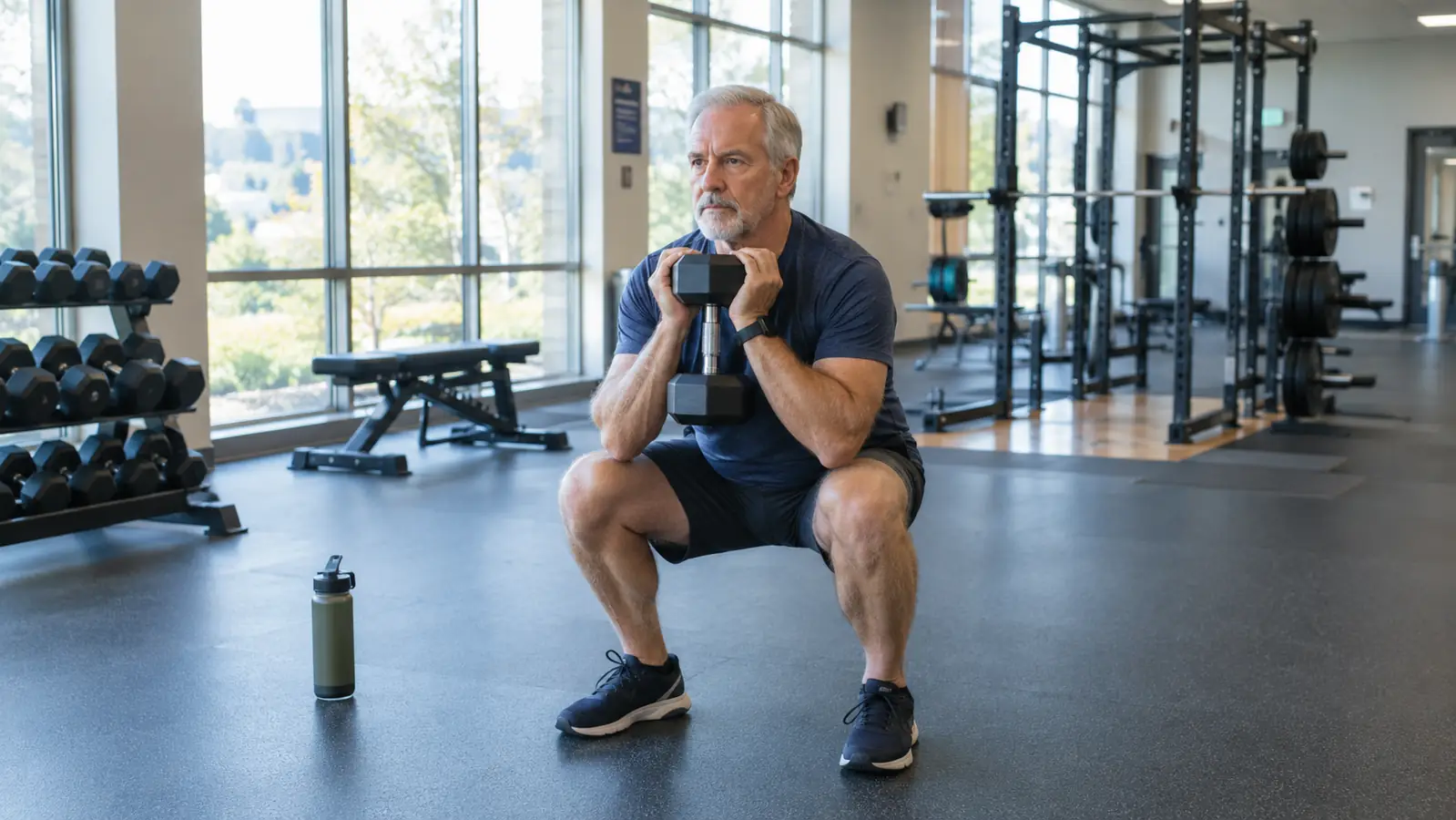
I started lifting at 60 because I was tired of struggling to carry groceries up the porch steps. Thirty-one years of walking a mail route in Chattanooga kept me moving, but once I retired, the strength went faster than I expected. Getting up off the floor got harder. Carrying a case of water felt like a job. So I joined the community rec center and started showing up three mornings a week, and that is when my doctor brought up something I had not thought about once: my bones.
A routine blood test at my yearly checkup showed my vitamin D was low. My doctor said that matters even more when you lift, because your bones are the frame the whole thing hangs on. He recommended a D3 supplement, and after checking with him first, I started taking Sports Research Vitamin D3 + K2, one small softgel with breakfast every day. At my recheck a few months later, he said my vitamin D level was back in a good range. This is how I went about it, in case you are over 50, you lift, and you are wondering whether D3 + K2 belongs in your routine. I am not a doctor, and I am not going to tell you what to do. I am going to tell you what I did, what my doctor said, and what the blood work showed.
The D3 + K2 I've taken every day for over a year
One small softgel with breakfast, because it needs some fat in the meal to absorb well. Sixty plantgels per bottle, and the softgel itself has coconut oil in it. I felt nothing day to day, which is normal for a vitamin. The proof came at my recheck, when my doctor said my vitamin D level was back in a good range. Ask your own doctor first, especially if you take blood thinners, because vitamin K2 interacts with them.
Amazon Check Today's Price on Amazon →The Five Steps I Followed
Step 1: Ask for a blood test before you add anything
I did not start with a supplement. I started with a question to my doctor at my yearly checkup: what should I actually be checking at 61? He ordered routine blood work, and the vitamin D result came back low. That changed the whole plan, because I had been assuming my levels were fine. I felt fine. That is the thing about vitamin D, you can run low for a long time and not feel a thing.
If you are over 50 and lifting, ask your own doctor about checking your vitamin D before you buy anything. The number tells you whether you even need a supplement and, if you do, how much. My doctor recommended a D3 supplement and wrote down a dose. I did not guess. Guessing is how people end up taking a lot of something they never needed.
This step also matters because D3 and K2 are not the only things that affect bones. Your doctor can check kidney function too, which matters if you are also thinking about protein powder or creatine. My doctor checked mine before I added creatine later, and it was fine. Get the blood work first, then build your routine from there.

Step 2: Lift three days a week, and write it down
I lift Monday, Wednesday, and Friday at the rec center. The routine is simple: leg press, goblet squats with a dumbbell, seated rows, chest press, and farmer carries at the end. Nothing fancy. I have been at it for three years and I still do the same five movements, because they work. The goal is progressive overload, adding a little weight or a couple of reps over time, and that is where the notebook comes in. I also walk most days I do not lift, usually a few miles along the riverfront, and I count those days as part of the same job.
I keep a spiral notebook with my lifts, my bodyweight, and how I slept. Every session gets a line. When I look back over a month, I can see the leg press creeping up from one weight to the next, and that tells me more than any scale. Lifting with progressive overload is what tells your body to keep bone and muscle, and the stress has to increase a little over time or your body has no reason to adapt. Lifting gives my bones the heavy load, and walking gives them the regular weight-bearing movement that keeps the whole system honest.
If you are new to lifting, start lighter than you think you need and learn the movements first. I spent the first weeks with light weights, and the notebook helped me see progress even when it felt slow. Strength work is the foundation of bone health as we age. Supplements support that work, they do not replace it.
Step 3: Get your protein in order before you add anything else
The honest order of operations is food first. I used to eat toast and coffee for breakfast and not much protein all day, and my son Daniel pointed it out after I admitted it to him. He suggested a whey protein shake, and my doctor agreed with the target we settled on: about 130 grams of protein a day. Once I stopped under-eating protein, my lifts climbed more steadily than after anything else I changed.
I take one scoop of Optimum Nutrition Gold Standard Whey in 2% milk after lifting, and on days I know I am short on protein, a shake at lunch too. It mixes in a shaker bottle in a few seconds, tastes like chocolate milk, and gives me no stomach trouble. Protein gives your body the material to build, and D3 + K2 help with the frame. They do different jobs, and you need both.
If your protein is already in order, great. If it is not, fix that before you buy any supplement. My doctor's words stuck with me: supplements come after food, sleep, and showing up to train. Nothing I take has ever made up for a day I skipped the workout or ate like I was still on the mail route.

Step 4: Take D3 + K2 with a meal that has some fat
The Sports Research Vitamin D3 + K2 is one small softgel a day, and I take it with breakfast because it needs some fat in the meal to absorb well. The softgel itself has coconut oil in it, and it is tiny and easy to swallow, which matters to me because I have choked on bigger capsules before. Why Sports Research? I read labels on a few D3 + K2 products, and this one was a vegan softgel with coconut oil, which made sense to me for absorption. I felt nothing day to day, and I want to be honest about that. A vitamin is not a stimulant. You do not feel it working.
The K2 part is why I chose this one over plain D3. My doctor explained that vitamin D supports calcium absorption, and vitamin K2 supports calcium being used in the right places. I am not going to overstate the research. I will say that when a doctor who has seen my blood work recommends the combination, I listen. He recommended D3, and I picked the version with K2 after reading the labels. I also liked that the serving is one softgel a day, not two or three. Fewer steps in the morning means I actually take it, and taking it every day is the whole point.
At my recheck a few months later, my doctor said my vitamin D level was back in a good range. That is the only result I can point to, and it is a real one. The bottle sits in the kitchen cabinet beside the fridge, and taking it is part of breakfast, same as the coffee. If you are on blood thinners, talk to your doctor before adding K2, because it interacts with them. Mine knows I take it. When people ask me what to take for their bones, I tell them to start with the blood test and the lifting, and to think of D3 + K2 as one small part of that.
Step 5: Give it eight weeks, then let the blood work tell you
My rule is one new supplement at a time, for at least eight weeks, with a notebook. When I added the D3 + K2, it was the only new thing in my routine. So when my recheck came back with my vitamin D in a good range, I knew what had changed. I did not expect to feel a difference in the gym, and I did not. The blood work was the proof.
Eight weeks is enough time to see whether a supplement agrees with you and long enough for a recheck to show a real change in a vitamin level. Keep the rest of your routine the same while you test, and change one thing at a time. That is the only way to know what is doing what, and it is the same method I have used for every supplement I take now.
Be patient with the rest. Bones remodel slowly, and strength comes in small increments you only see in the notebook after a few weeks. The D3 + K2 is one small part of a routine that includes lifting, protein, sleep, and walks along the riverfront with my wife Joanne. It supports the work. It does not do the work. It is not a quick fix, and I would never promise anyone a result. What I can tell you is what happened with my own numbers.
What Else Helps
Beyond the softgel, the things that helped my bones most did not cost anything. Sleep is the first one. I sleep better on lifting days, and I protect that. Walking most other days, usually a few miles along the riverfront with Joanne, keeps me moving without pounding my knees, which have their own opinions after 31 years of pavement. Weight-bearing movement of any kind gives your bones a reason to hold on to density.
Calcium from food is the other half of the equation. D3 and K2 help your body use calcium, but they are not a substitute for getting it. Dairy, leafy greens, and fortified foods all show up in my day, and my doctor has never told me I need a calcium supplement. And I will say it plainly: ask your own doctor first. Anyone on blood thinners needs to check before K2, and anyone with kidney concerns needs to check before protein and creatine. That is not a disclaimer, it is the step I took myself.
I try to get outside most days too, even just ten minutes on the porch with coffee, because sunlight is how your body makes its own vitamin D. It is not a substitute for a supplement when your level is already low, but it does not hurt. One more thing about the softgel itself: the Sports Research bottle gives me 60 plantgels, which is two months at one a day, and the softgels are vegan, which mattered to Joanne when she started taking them too. She takes the D3 + K2 and the collagen, and she does not use the whey or the creatine. If you live with someone who wants the same support, it is nice when one bottle works for both of you.
I felt nothing day to day, which is normal for a vitamin. The proof came a few months later, when my doctor said my vitamin D level was back in a good range.
Start with a blood test, then lift, then add D3 + K2
That is the order that worked for me, and it is the order I would do again. One small softgel with breakfast, 60 plantgels per bottle, and the rest of the routine is showing up three days a week and eating enough protein. Check with your own doctor first, especially if you take blood thinners or have kidney concerns.
Amazon Check Today's Price on Amazon →