

I started lifting at 60 because carrying groceries up the porch steps got harder. That was the honest moment. I had walked a mail route for 31 years, and after I retired the strength went faster than I expected. Getting up off the floor was harder. Carrying groceries up the steps was harder. So I started lifting three mornings a week at the community rec center, and I have kept at it for three years now.
The knees that carried me through that route get creaky on the porch stairs. Nothing dramatic, just a reminder that I am 63 and that I spent three decades walking on pavement. Joanne suggested I try Sports Research Collagen Peptides after she read about collagen for joint comfort. I told her I would give it eight weeks, one new thing at a time, the way I test everything. She takes it too now, and this is how I worked it into my routine without making it complicated.
One scoop in your morning coffee, eight weeks, honest notes.
Sports Research Collagen Peptides dissolves clean in hot coffee with no taste and no texture, which makes it the easiest supplement I take all day. Check today's price on Amazon and see if it fits your routine.
Amazon Check Today's Price on Amazon →Step 1: Ask your doctor before you add collagen or anything else.
I am not a doctor, and I do not play one in an article. I asked my own doctor before I started collagen, just like I did with the whey, the vitamin D and the fish oil before it. He knows my history and my blood work. You should do the same, and that conversation takes five minutes.
Collagen is generally well tolerated, but that does not mean it is zero risk for everyone. If you have kidney concerns, if you take medication, or if you have surgery planned, your doctor is the right person to clear it. This is not me being cautious for no reason. It is the difference between a supplement that supports you and a supplement that interferes with something else.
This matters more as you get older. My doctor checks my kidney function regularly, and he cleared creatine only after that check came back fine. I take collagen, vitamin D and K2, fish oil, whey, and creatine now, and every single one of them started with a conversation with him. That is the rule I use, and I think it is the right one for anyone over 50.
Step 2: Start with food and sleep, then add collagen as support.
Collagen is not a fix. It is a support. I did not expect it to undo decades of walking a mail route, and it did not. What it did was slide into a routine that was already working, and that is the order that makes sense to me: build the foundation first, then add the supplement. If the foundation is shaky, the supplement does not get a fair test.
I eat breakfast every day now, which I did not always do. One scoop of Sports Research Collagen Peptides goes into my coffee, and I take the D3 and K2 softgels with food. Collagen does not count toward my protein target, because it is not a complete protein. I get my real protein from food and a whey shake on lifting days, and that is what lets my lifts climb steadily.
If you skip sleep and eat poorly, no scoop of anything will save you. Get the basics right first. Then the collagen has a foundation to work on, and you will know whether it is helping because everything else is steady. That is the only way to test a supplement honestly.
Step 3: Take it daily, at the same time, in something hot or cold.
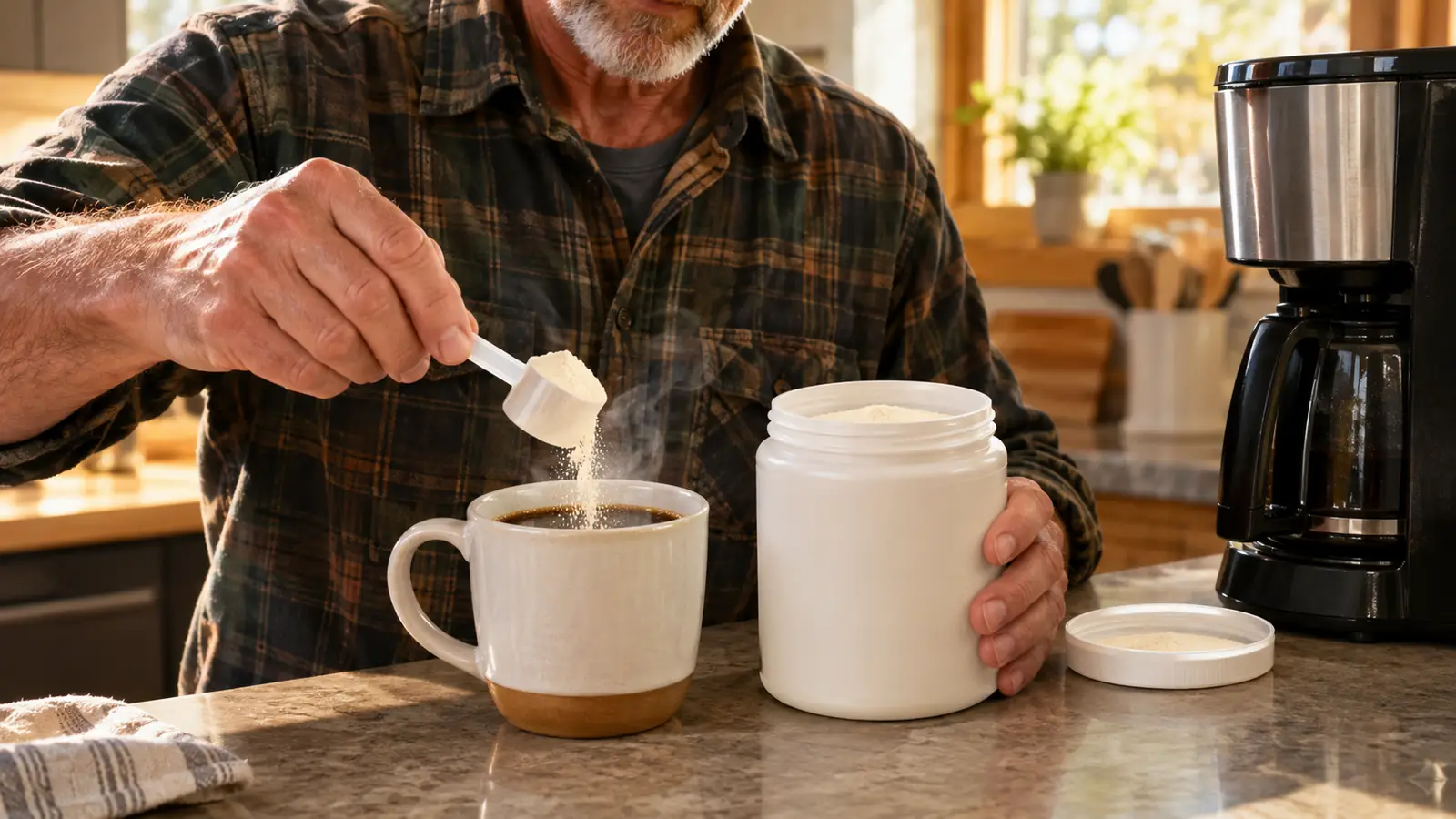
The tub sits on my kitchen counter next to the coffee maker, so I cannot miss it. One scoop, unflavored, stirred into hot coffee. It dissolves completely, no taste, no grit. That is the whole ritual, and it takes about thirty seconds. If a supplement is hard to take, you will not take it, so I made this one as easy as possible.
Consistency matters more than timing. I take mine at breakfast because that is when I remember. Joanne takes hers the same way. Some people stir it into cold water or yogurt; the unflavored version is flexible. Pick a time you will actually repeat, and make it visible so you do not forget. The counter next to the coffee maker works for me.
Eight weeks is my minimum for any supplement. One new thing at a time, logged in the notebook. That is the only way I can tell what is doing anything, and it is also the only way I can honestly tell you what happened. I did not start collagen and creatine in the same week. I gave each one its own test.
Step 4: Keep lifting, because collagen does not build the muscle.
Collagen supports joints. Lifting builds strength. You need both. I do leg press, goblet squats with a dumbbell, seated rows, chest press, and farmer carries three mornings a week, and I walk a few miles along the riverfront most other days. The training is the part that changes your body.
I log every lift in my spiral notebook: weight, reps, how I slept, how the knees felt. That notebook is what tells me whether something is working. Not a feeling, not a mood, a number. It is the same notebook I have used since I started lifting at 60, and it is the closest thing I have to a lab report.
The collagen did not make me stronger. The training did. What I noticed was that my knees felt a little less creaky on the porch stairs after a couple of months. I cannot prove the collagen caused that, and I told Joanne the same thing. But I kept taking it because it is easy and it does not hurt, and because the trend in my notebook was good.
Step 5: Judge it honestly after eight weeks.
Here is the honest report: my knees feel a little less creaky. That is a small change, not a transformation. I did not wake up one morning with new knees. I just noticed one day that I was not bracing myself on the stairs the way I used to. That is the kind of change I trust, because it is small and specific.
I rate Sports Research Collagen Peptides 4 out of 5. It does what I ask of it: it is easy to take daily, it dissolves clean in coffee, and it supports my joints while I keep lifting. It is not magic, and I would not call it that. It is a reasonable part of a routine that also includes food, sleep, and showing up.
If you decide to try it, give it eight weeks, keep your training consistent, and ask your doctor first. That is the honest formula I use for everything, and it is the same advice I would give you over the fence. Start with one thing, log it, and let the notebook tell you the truth.
What I Wish I Knew Before I Started
I wish I had started collagen years ago, but not because it is magic. I wish I had started it because it is so easy to add, and because the habit of taking something daily taught me to be consistent with everything else. The routine matters more than the powder.
I also wish I had known that collagen is not a complete protein. I do not count it toward my protein target. That saved me from fooling myself into thinking a scoop of collagen was a scoop of whey. They are different tools for different jobs.
Finally, I wish I had known how much the small stuff adds up. Walking a few miles most days, eating breakfast, getting to the rec center three mornings a week. The collagen is the smallest part of that. But it is the easiest part, and sometimes the easiest part is the one that keeps the whole routine going.
One more thing: do not stack five new supplements at once. I tested each one for eight weeks before I added the next. That is slower, but it is the only way to know what is working. If you change everything at once, you will never know what helped and what was just noise.
How to Know If It Is Working
You will not feel collagen the way you feel a good night of sleep. The signs are quiet. For me it was the porch stairs. I used to brace myself a little, and after a couple of months I noticed I was not bracing. That is the kind of signal to look for, not a dramatic pop.
Write down where you feel stiff and rate it on a scale of one to ten before you start. Do the same every Sunday. If the number drifts down over eight weeks, that is useful information. If it stays the same, that is also useful information. Either way, you are not guessing.
I also kept lifting the whole time. That is important. If you add collagen and stop training, you will not know what is helping. Keep the training steady, keep the sleep steady, and let the supplement be the only thing that changes. Then the notebook gives you a real answer.

What Else Helps
Collagen is one piece. The other pieces that helped me: vitamin D3 and K2 after my blood test came back low, fish oil because I rarely eat fish, whey to hit my protein target, and creatine for a few more reps on leg press and seated rows. I added each one separately, with my doctor's blessing, and I logged what happened. None of them replaces the work. All of them support it.
The order mattered. I started with whey at 61 because my son Daniel pointed out that I was eating toast and coffee for breakfast and not much protein all day. Then vitamin D and K2 at 61 after my yearly checkup showed low vitamin D. Then fish oil at 62. Then collagen at 63, early in the year. Then creatine at 63, after my doctor checked my kidneys. Each one got its own eight weeks, and each one had to earn its place in the routine.
You do not need all of these. I am not telling you to go buy five things. I am telling you what I take and why, so you can talk to your doctor with a clear list. Collagen on its own, with food, sleep, and training, is a reasonable place to start.
The Bottom Line
The bottom line is simple. Collagen supports, training builds, and the notebook tells the truth. I take Sports Research Collagen Peptides every morning in my coffee, Joanne takes it too, and we both feel like it earns its place. Ask your doctor, give it eight weeks, and decide for yourself.
I have been taking it since early in the year, and it is still in my routine. That is the real test for me. A supplement that does not earn its place gets dropped when the tub runs out. This one earned it. Not because it changed my life, but because it is easy, it supports my joints, and it does not get in the way of the work that actually builds strength.
My knees felt a little less creaky on the porch stairs after a couple of months. I cannot prove that was the collagen, and I told Joanne the same thing.
Eight weeks, one scoop a day, honest notes.
If you lift over 50 and your joints complain, Sports Research Collagen Peptides is a simple thing to try. It dissolves in coffee, it has no taste, and it supports rather than promises. Check today's price on Amazon.
Amazon Check Today's Price on Amazon →