

At 63, I am the oldest regular in the free-weight corner of our community rec center. I started lifting at 60 because carrying a bag of groceries up the porch steps got embarrassing. Somewhere around my 63rd birthday, I asked my doctor about creatine. I had read that a lot of the research was done on younger men, but the studies that include older adults point the same direction. He checked my kidney function first, said go ahead, and for eight weeks I added one scoop of Optimum Nutrition Creatine Monohydrate a day and changed nothing else.
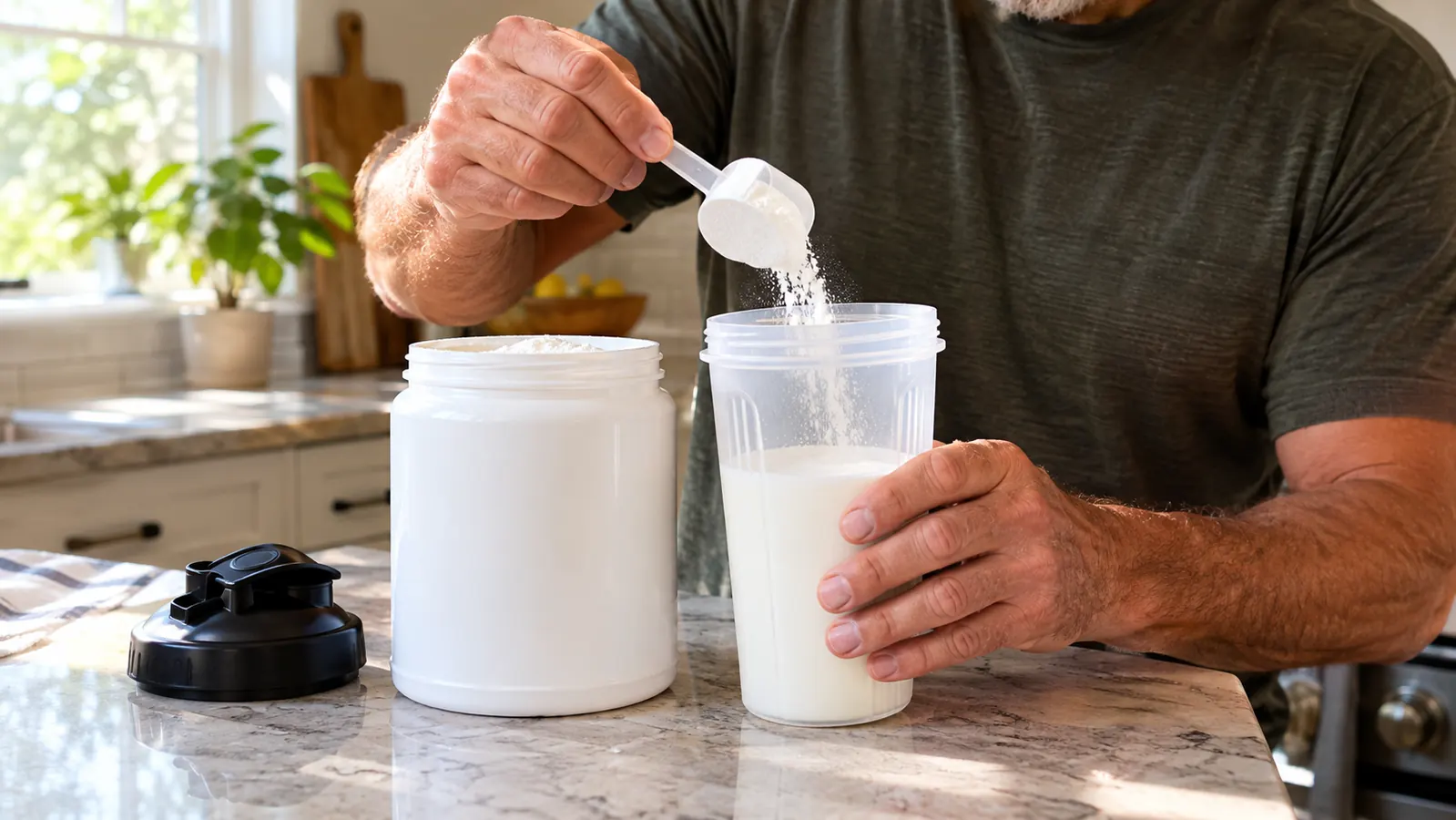
Here is my method. One supplement at a time, at least eight weeks, everything written in the same spiral notebook I use for my lifts. I track bodyweight, how many reps I get on leg press and seated rows, and how I sleep. I did not do a loading phase on creatine. I just took one level scoop, five grams, every single day, mixed into the whey shake I have after Monday, Wednesday, and Friday workouts, or into a glass of water on the other days. A little grit settles at the bottom of a cold glass of water; none does in the milk shake.
The tub I have used every day for eight weeks
Optimum Nutrition Creatine Monohydrate, unflavored, one scoop a day, no loading phase, and honest notes on what it did and did not do for a 63-year-old lifter.
Amazon Check Today's Price on Amazon →Why I added creatine at 63
Here is the detail that settled it for me. My doctor said my kidneys were fine, and then he gave the honest version. Creatine is one of the most studied supplements in the world, the evidence in older lifters is reasonable, and the main thing he checks before anyone starts is kidney function. That is because creatine can raise a marker in your blood called creatinine, which is related to kidney function, not the same as kidney damage. He told me to repeat my bloodwork at my next checkup, and I did. That conversation is why I tell every reader to ask their own doctor first, especially anyone with kidney concerns.
The first two weeks did the one thing that makes most people quit. My weight went up about three pounds, and that is expected water sitting inside the muscle. It is not fat. My doctor had warned me, so I did not panic. Then, right around the four-week mark, I noticed I was getting a couple more reps on leg press and seated rows at the same weight as before. That is the part no label can promise, but the notebook can show.
The 10 reasons I stuck with it
It supports the work you are already doing
Creatine does not build muscle by itself. It helps your muscles produce a little more energy during hard sets, which is why I got two extra reps on leg press around week four. At our age, an extra rep or two at the same weight is a real win, because it means the work I was already doing counts for more.
Amazon See how Optimum Nutrition creatine fits a lifting routine →
No loading phase, no complicated protocol
Some creatine guides tell you to take a bigger dose for the first week. I skipped all that. One scoop a day, five grams, every day, from day one. The simpler the habit, the more likely a 63-year-old with a spiral notebook actually keeps it.
It disappears into a routine you already have
I mix my scoop into the whey shake I have after lifting, or into a glass of water on off days. It is unflavored, so it does not change the taste. No clumps in the milk shake; a little grit settles at the bottom of cold water, which does not bother me.
It pairs with protein instead of replacing it
Creatine and protein do different jobs. My protein target is about 130 grams a day, and the whey helps me hit it. Creatine covers the energy side of the equation. I would not trade one for the other.
It supports recovery between lifting mornings
I lift Monday, Wednesday, and Friday, and walk the rest of the week. Research links creatine to supporting recovery after resistance training, which is exactly when a 63-year-old body needs the help.

The early weight gain is water, not fat
My first two weeks added about three pounds, and it was water sitting inside the muscle. That is expected, and it stays as long as you keep taking creatine. Knowing this beforehand kept me from quitting. It also made my shoulders look fuller in a t-shirt, which I did not complain about.
It is one of the most studied supplements there is
Creatine has been studied for decades, in younger athletes and in older adults, on everything from strength to balance. I like betting on the thing with the biggest file of research behind it. That evidence is why my doctor said go ahead, and why I felt confident staying past the eight-week mark.
The gains showed up in my notebook, not in my head
I do not trust feelings after a month of any supplement. My spiral notebook shows the leg press and seated row numbers climbing at the same weight right around week four. That is the only proof I trust, and it is why Optimum Nutrition creatine scored 4.5 out of 5 from me.
One tub lasts a good long while
This is the 120-serving size, and I take one scoop a day, so a single tub covers me for roughly four months. I used a tub of Nutricost creatine first, and it worked the same as this one. I preferred the Optimum Nutrition tub and scoop, so I switched when it ran out.
It survived the eight-week honesty test
Here is the plain version. Nothing dramatic happened, no fireworks, no dramatic before-and-after. What happened was a steady couple of extra reps and a habit that was easy to keep. For something that only asked one scoop a day, that is a fair trade, and it still sits on my pantry shelf.
What I'd Skip
Skip creatine if your doctor has told you to watch your kidneys, or if you are not actually training. Creatine supports the work you are doing; it is not a substitute for showing up. That is the part no label can tell you. Also skip it if you expect a supplement to fix a protein-poor diet or a bad sleep habit. My standard line still holds: supplements come after food, sleep, and showing up to train. If you are on any medication, or you have kidney concerns, ask your own doctor before you buy a tub. Mine checked my bloodwork first, and I think that is the right order.
The notebook showed the leg press climbing around week four. That, not a feeling, is why I kept taking it.
The same question I asked myself: was one scoop a day worth it?
For me it was. A couple more reps on leg press, a weight bump I was warned about, no loading phase to forget, and a tub that lasted months. Ask your doctor first, then judge it the way I did: eight weeks, a notebook, and nothing else changed.
Amazon Check Today's Price on Amazon →