
I started lifting at 60 because carrying groceries up the porch steps got harder every month. By 61, I had a routine at the rec center three mornings a week, but I was still eating toast and coffee for breakfast and not much protein the rest of the day. My son Daniel, who lives in Atlanta, heard me say that and told me to try a whey protein shake. He suggested Optimum Nutrition Gold Standard Whey, the Double Rich Chocolate flavor. I had never used a protein powder in my life. Two years later, it is still the one supplement I reach for on every lifting day.
This is not a review written after a two-week trial. I have used this tub for over two years, logged my lifts and bodyweight in a spiral notebook the whole time, and I have a clear before and after: once I stopped under-eating protein, my lifts climbed more steadily. Here is the long-term picture, including the parts that are not glamorous.
For context, whey was the first supplement I ever tried. I started lifting at 60 at the community rec center, Monday, Wednesday and Friday mornings, and for the first year I made decent progress and then stalled. My son Daniel asked what I ate in a day, and when I told him toast and coffee for breakfast and not much protein after that, he said, Dad, that is your problem, and he suggested Optimum Nutrition Gold Standard Whey. I asked my doctor, ran my eight-week test, and I have kept it ever since.
The Quick Verdict
Optimum Nutrition Gold Standard Whey made my daily protein target easy to hit, mixes in seconds, and gave me no stomach trouble in two years of use. It is not magic, but it fixed a real gap in my diet.
Amazon Check Today's Price →The shake that finally made my protein target easy
One scoop in 2% milk after lifting, and I stopped under-eating protein for the first time in years. Check today's price on Amazon.
Amazon Check Today's Price on Amazon →How I've Used It
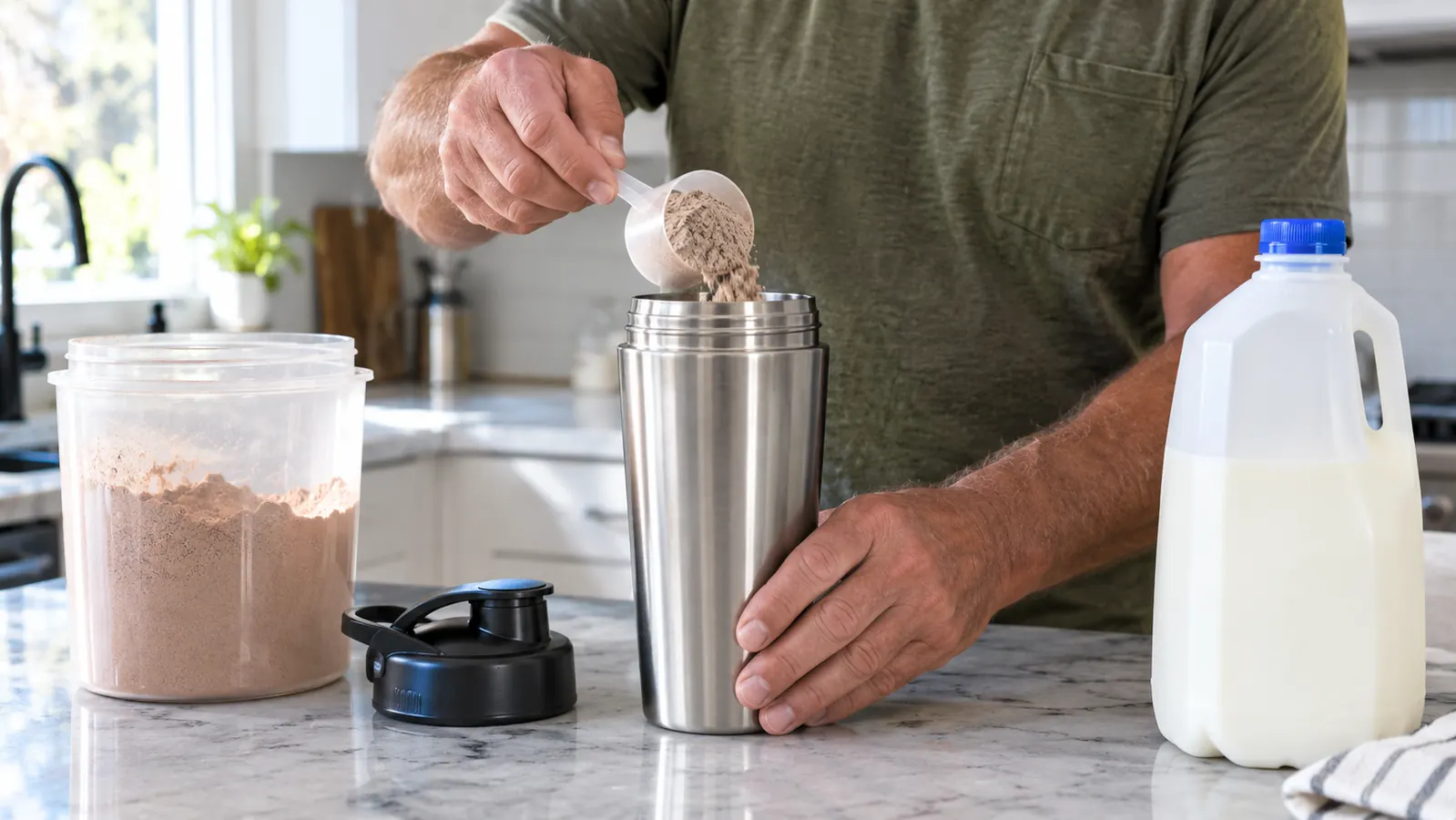
My routine is simple. On Monday, Wednesday and Friday, after I finish at the rec center, I mix one scoop of Gold Standard Whey with 2% milk in a shaker bottle. It takes a few seconds to mix, no clumps, and it tastes like chocolate milk. On days I know I am short on protein, I have a shake at lunch instead. The tub lives on the pantry shelf, and the shaker bottle lives in the dish rack.
I use 2% milk, not water, because with water the shake is thinner and flatter. With milk it is genuinely good. I have never had stomach trouble from it, which matters to me because I have read that some people do poorly with certain protein powders. That was not my experience.
Milk first, then the powder, then shake for about ten seconds. If you put the powder in first, it sticks to the bottom in a paste you will be scraping out with a spoon. I learned that the first week. With milk first, Optimum Nutrition Gold Standard Whey mixes smooth in the shaker with no clumps, and I drink it standing at the kitchen counter before my shower. The shaker goes into the dish rack right away. A shaker that sits all morning in a warm car is a lesson you only need once.
Before I started, my doctor and I agreed on a protein target of about 130 grams a day. I was nowhere close. One shake gives me about 24 grams, and suddenly the daily number was reachable. That is the whole story of why this tub is still on my shelf.
To get to that number, I started writing down everything I ate for one week. It was humbling. On a normal day I was eating about 70 grams, which is well short for a man my size who is trying to build muscle at 61. Breakfast was the big hole. I now eat eggs and Greek yogurt in the morning, and the shake after lifting fills the rest. On non-lifting days I usually get there with food, and I only make a lunch shake when I know I am short, like the day after a family cookout where I mostly ate potato salad.
What the Scoop Actually Gives You
Gold Standard Whey is a blend of three protein sources: whey protein isolate, whey protein concentrate, and hydrolyzed whey peptides. I am not a chemist, so I will put it the way my doctor put it to me: the isolate part means you get a good amount of protein per scoop without a lot of extra fat and lactose. That is one reason it sits well with people who have trouble with milk.
Each scoop is about 24 grams of protein, and the tub I buy is the 2 pound size. I am not going to quote the full nutrition panel from memory, because I would get it wrong. What I can tell you from the label I read every time I open the tub: the protein number is the headline, and the carbohydrate and sugar numbers are low enough that I do not think about them.
The Double Rich Chocolate flavor is the one I have used the whole time. I cannot compare it to the other flavors because I have not tried them. I can tell you that with 2% milk it tastes like chocolate milk, and that my wife Joanne, who does not use whey herself, has smelled it and said it is not offensive. That is about as high a compliment as a protein powder gets in this house.
With water it is a different story. It turns thin and a little flat, which is why I have used 2% milk the whole time. I have never tried another flavor, partly because I am a creature of habit and partly because chocolate goes down easily after a hard leg day. If you hate chocolate, there are many other flavors listed, but I can only speak for this one.
What Changed Over Two Years
The honest answer is that the whey did not make me stronger by itself. What it did was remove a bottleneck. I was lifting three days a week and eating like someone who did not lift. Once the shake made my protein target easy, my lifts climbed more steadily. In my notebook, the leg press and seated row numbers went up in smaller, more consistent jumps instead of stalling for weeks.
I also weigh about 185 pounds, and my weight has stayed stable. The whey did not add body fat, and it did not make me bulky. At 63, I am not trying to get huge. I am trying to keep the strength I rebuilt, and the shake is part of how I do that.
Here is what my notebook shows in plain terms. In the year before whey, my leg press went up, stalled for weeks, went up, then stalled again. After I started hitting my protein target with a shake on lifting mornings, the climb was steadier, with fewer flat stretches. My seated rows did the same. I cannot claim the whey did that by itself, because I was also getting better at the movements. I can say that every long stall in the notebook since then lines up with a stretch where I skipped shakes and under-ate protein.
One thing I noticed early: the shake is filling. On days I have it after lifting, I am not raiding the kitchen an hour later. That alone probably helped me as much as the protein number.
The other change was in my habits, not my body. Once the shake was part of every lifting morning, I started planning the rest of my meals around protein instead of guessing. Joanne noticed I was asking what was for supper by noon, which she found funny. The shake did not change how I felt day to day. It changed how much attention I paid to food, and that attention is what kept the numbers in my notebook moving in the right direction, a little at a time.
The whey did not make me stronger by itself. It removed a bottleneck: I was lifting three days a week and eating like someone who did not lift.

The Downsides Nobody Mentions
First, the price. I will not quote numbers here, but this is not the cheapest protein powder on the shelf, and the 2 pound tub does not last forever when you use it three or four times a week. I watch for a good price and buy when the price is reasonable. That is just common sense.
Second, the scoop is generous. One scoop is the serving, and it is easy to make a heaping scoop without meaning to. If you are tracking protein closely, level the scoop. I learned that from my notebook, where a few weeks of heaping scoops showed up as extra calories I did not plan.
Third, it is a supplement, not a meal. I have seen people treat a shake as breakfast and call it a day. That is not what this is for. I use it after lifting or on days I am short on protein, and I still eat real food. My rule: supplements come after food, sleep, and showing up to train.
What I Liked
- Mixes smooth in a shaker bottle in about ten seconds
- Double Rich Chocolate tastes good with 2% milk
- Made a daily protein target of about 130 grams easy to reach
- No stomach trouble after training
- Strong Amazon star ratings from tens of thousands of reviews
Where It Falls Short
- Thin and flat with water
- Made from milk, so not for anyone with a dairy problem
- Easy to lean on a shake instead of real meals
- Ask your doctor first if you have kidney concerns
Fourth, check with your doctor about your kidneys before you push your protein up. I know that sounds like a line every supplement article throws in, but at our age it is real. My doctor looked at my blood work before he agreed to the 130-gram target. If you have kidney concerns, or you have been told to limit protein for any reason, that conversation comes first. And if dairy bothers your stomach, ask about a whey isolate or a non-dairy protein instead, because Gold Standard Whey is made from milk.
Who This Is For
This is for the person who is already training and knows they are not eating enough protein. If you are over 50, lifting a few days a week, and living on toast and coffee like I was, a whey shake is the easiest fix I know. It is also for anyone who wants a protein powder that mixes clean, tastes good with milk, and does not upset their stomach.
I would also say this: if you are over 50 and thinking about starting to lift, the whey can wait. Start with the training. Once you are consistent, the shake becomes useful. It is a support, not a starting line.
If you are just starting, my advice is to begin with the food side first. Write down what you eat for a week, find the gap, and see how much of it you can close with eggs, yogurt, chicken and beans. If you are still short, a scoop of Optimum Nutrition Gold Standard Whey after training is the easiest fix I have found. One scoop, a cup and a half of milk, ten seconds of shaking. It is not complicated, and that is exactly why it works for somebody who is 63 and has better things to do.
Who Should Skip It
Skip it if you already get enough protein from food. I know people who eat eggs, chicken, and Greek yogurt all day and do not need a powder. Good for them. Skip it if you have a diagnosed kidney condition, because high protein intake is something your doctor should weigh in on. And skip it if you are looking for a product that will do the work for you. No powder does that.
Also, if you are on medication or have any health concerns, ask your doctor before adding any supplement. I asked mine before I started, and I am glad I did. That is not a disclaimer I tack on. That is the advice I would give my own son.
Still the tub on my pantry shelf after two years
If you train and under-eat protein, this is the shake that fixed it for me. Check today's price on Amazon.
Amazon Check Today's Price on Amazon →