
I turned 63 this year, and I have a confession: I spent most of my life not thinking about muscle at all. I carried mail for 31 years, which kept me on my feet, but it did not keep me strong. After I retired, I noticed it fast. Groceries got heavier. Getting up off the floor after fixing a kitchen cabinet hinge took a real effort. My wife Joanne would ask me to open a jar and I would hand it back to her. That was the moment I started lifting at the community rec center, three mornings a week, at age 60.
Here is what I learned the hard way: after 60, muscle does not just stay put because you used to be active. You have to train it, feed it, and in my case, give it a little help. The newest help in my routine is creatine. Not a fancy formula, just plain creatine monohydrate. This is the exact routine I used, step by step, including the mistakes I made so you do not have to make them.
The Same Creatine I've Used Every Day for Months
Optimum Nutrition Creatine Monohydrate is the unflavored powder I mix into my post-lift shake. No loading phase, no fancy flavors, just 5 grams a day. Check today's price on Amazon and see if it fits your routine.
Amazon Check Today's Price on Amazon →Step 1: Ask Your Doctor and Get Bloodwork Done First
Before I bought any creatine, I asked my doctor. I am 63, and I wanted to know if creatine was safe for someone my age. He did not wave me off. He ordered bloodwork, checked my kidney function, and when the numbers came back fine, he told me to go ahead. That conversation is the reason I can tell you this routine with a clear conscience.
If you have kidney concerns, high blood pressure, or take any medication, do not skip this step. Creatine is one of the most studied supplements in the world, but your doctor knows your history. Ask first. It took me one appointment and one blood draw, and it gave me peace of mind for every scoop since.
One more thing: if you are on a blood thinner, the same conversation matters for fish oil and vitamin K2, which I also take. My doctor went over each of those when I started it, one at a time. That is the right way to start any supplement, especially at our age.
Step 2: Pick Plain Creatine Monohydrate, Not a Fancy Blend
There are a hundred creatine products on the shelf. There is creatine with flavors, creatine with caffeine, creatine gummies, creatine capsules, and blends that cost twice as much. I chose Optimum Nutrition Creatine Monohydrate, unflavored, in the big 120-serving tub. Why? Because the research on creatine is mostly about creatine monohydrate, and because I wanted the simplest version I could take every single day.
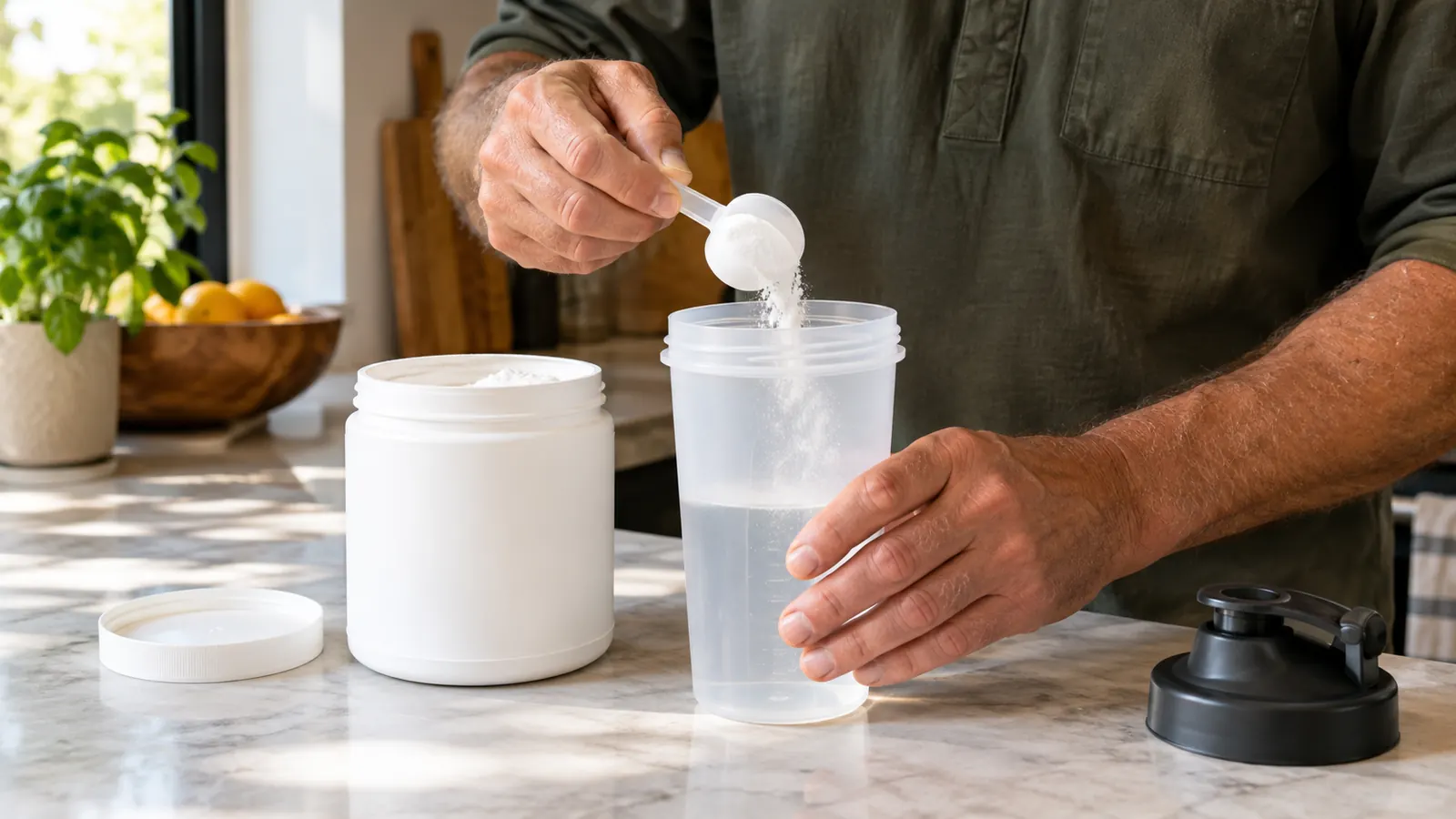
The unflavored powder has no taste, which matters more than you think. I mix it into a whey protein shake on lifting days and into a glass of water on other days. It mostly dissolves. A little grit settles at the bottom of cold water, but I do not notice it in the milk shake. No loading phase, no stomach trouble, no complicated schedule. One scoop, once a day, every day.
I settled on Optimum Nutrition Creatine Monohydrate because it is exactly that: plain creatine monohydrate, one ingredient, in a tub with a scoop that measures five grams when you level it. Nothing added for flavor, nothing added for energy. When I asked my doctor, that simplicity was the first thing he liked. He could read the label in two seconds and know what I was taking. If you are on any prescriptions at all, that matters. A blend with ten ingredients is ten more things to check, and at our age we already have enough bottles in the cabinet.
I used a different tub of creatine for about a month before this one, and it worked the same. I switched to Optimum Nutrition because I preferred the tub and the scoop, and because the brand is one I already trusted from my whey protein. The scoop is a real 5-gram scoop, which removes all the guesswork.
Step 3: Take 5 Grams Every Day, Including Rest Days
The dose that worked for me is simple: 5 grams a day, every day. No loading phase. Some labels tell you to take a big dose for the first week, but the research I read and the advice my doctor gave me both pointed to the same place. A steady 5 grams a day builds up in your system over a couple of weeks. You do not need to shock your body with a huge starting dose.
Here is the part people get wrong: you take it on rest days too. Creatine is not a pre-workout. It does not give you a jolt before you lift. It works by helping your muscles recharge their energy stores over time, so the daily habit matters more than the timing. I take my scoop with breakfast on non-lifting days, and with my post-lift shake on Monday, Wednesday, and Friday.
In the first two weeks, my bodyweight went up about three pounds. That is water moving into the muscle, and it is expected. It is not fat, and it is not a reason to stop. I wrote it in my notebook, shrugged, and kept going. By the end of the first month, I was getting a couple more reps on leg press and seated rows at the same weight. That is the effect I was after.
How you take it matters less than taking it. On lifting mornings I mix the scoop into my whey shake with 2% milk after the rec center, and it disappears completely. On rest days it goes into a glass of water at breakfast. In cold water a little grit settles at the bottom, so I give it a stir and drink it down. Some people take it at night, some take it with juice. I have read nothing that convinced me the timing matters much. Pick a time you already eat or drink something every single day, and attach the scoop to it.

Step 4: Pair Creatine With Enough Protein, Especially After 60
Creatine helped me, but it did not do the work alone. The bigger problem I had after retiring was protein. I used to eat toast and coffee for breakfast and not much protein all day. My son Daniel, who lives in Atlanta, pointed that out after I admitted it to him. He suggested a whey protein shake, and that is when my lifts started climbing more steadily.
My doctor and I landed on about 130 grams of protein a day. That number is not a magic formula for everyone, but it is what we agreed on for my size and my training. I get most of it from food: eggs, chicken, Greek yogurt, milk. The whey shake after lifting helps me close the gap on days when food alone is not enough. One scoop of Optimum Nutrition Gold Standard Whey in 2% milk, with my creatine scoop mixed into the same shaker bottle.
If you are over 60 and trying to keep muscle, protein is the foundation and creatine is the support. I would not skip either one. The shake tastes like chocolate milk, mixes in a few seconds with no clumps, and gives me a reason to look forward to the routine. On non-lifting days, I only have a shake at lunch if I know I am short on protein.
Step 5: Train Consistently and Log Everything
Creatine is not a pill that builds muscle while you sit on the couch. It helps you get more out of the training you actually do. For me, that means Monday, Wednesday, and Friday at the rec center: leg press, goblet squats with a dumbbell, seated rows, chest press, and farmer carries. I walk a few miles along the riverfront most other days. That is the whole program, and it is enough.
I keep a spiral notebook with my lifts, my bodyweight, and how I slept. That notebook is the reason I can tell you creatine made a difference. I saw the same weights start moving for more reps after about a month. Without the notebook, I would have been guessing. Write down what you lift. It is the only honest way to know if something is working.
Start light if you are new. I began with machines and a light dumbbell, and I still do not do anything heroic. The goal is to show up three times a week for years, not to impress anyone on one Tuesday. Consistency beats intensity when you are 63.
Here is what my first month looked like, so you have something to compare against. Week one, nothing at all, except the scale moving up a pound. Week two, two more pounds, still no change on the leg press. Week three, I got one extra rep on the seated row at the same weight and wrote it down with a question mark. By week four the extra reps showed up on leg press too, a couple at a time. None of it felt dramatic in the moment. It only looked like progress when I flipped back through the notebook. That is why I tell everyone to write it down.
What Else Helps
Creatine is the newest supplement in my routine, but it is not the only one. I take a vitamin D3 plus K2 softgel with breakfast because a blood test showed my vitamin D was low, and my doctor recommended it. I take fish oil because I rarely eat fish. And I stir a scoop of collagen into my morning coffee for my knees, which feel a little less creaky on the porch stairs. Joanne takes the collagen and the D3 plus K2 too.
I want to be honest about what these do. The D3 brought a low blood test back into a good range on my recheck. The fish oil and collagen are things I take for long-term support, and I cannot prove they do anything dramatic. Supplements come after food, sleep, and showing up to train. If you are not sleeping and not eating enough protein, no powder in the world will save the routine.
After about a month on creatine, I was getting a couple more reps on leg press and seated rows at the same weight. That is the kind of change you can write down in a notebook and believe.
Start With the Same 5-Gram Scoop I Use
Optimum Nutrition Creatine Monohydrate is unflavored, mixes easily, and comes with a real 5-gram scoop. It has tens of thousands of reviews on Amazon and a 4.6-star rating. Check today's price and talk to your doctor before you start.
Amazon Check Today's Price on Amazon →